

One of my favorite parts of publishing The Reported Essay over the last two years has been hearing from readers. Many of you have reached out and mentioned projects you are working on, stories you are trying to tell, questions about pitching, or revisions you are wrestling with.
This summer, I’m hosting a limited number of 30-minute video or phone chats for paid subscribers. These one-on-one Summer Writer Sessions are to discuss your work, ask questions, and think through next steps.
Meetings are available only on a first-come, first-served basis. You can reserve a slot here, and please fill out this form when you do.
Minda & Zora
Earlier this year, I met the dynamic and talented writer Minda Honey, author of the “The Heartbreak Years,” who teaches nonfiction writing and runs the newsletter “Writing for Fakers.” She also recently launched “Craft Club,” where members discuss craft books like “Meander, Spiral, Explode.”
Minda and I had the privilege of serving on the 2026 Feature Jury for the Pulitzer Prizes, and during one of our breaks over those snowy couple of days in New York, we got to talking about the ups and downs of book publishing, and our mutual admiration for Zora Neale Hurston.
Minda is writing a new book that delves into Hurston’s life, entwining the lessons she learned from the famous author’s writing with her own experiences.

A few weeks before we convened in New York, I taught Hurston’s narrative nonfiction in one of my classes—her 1952 series “On the Trial of Ruby McCollum,” about a Black woman accused of killing a white doctor. You can find the series reprinted in its entirety in the collection of Hurston’s essays, “You Don’t Know Us Negroes.”
For my new video series at The Reported Essay, “Writers Reading,” I was delighted to continue talking with Minda about Hurston, and what her life teaches us about being writers.
Minda and I also chatted about book writing, freelancing, pitching your next project to a publisher, and finding your audience.
Her essays on politics and relationships have appeared in Harper’s Bazaar, the Los Angeles Review of Books, The Washington Post, The Guardian, Oxford American, Harvard’s Nieman Storyboard, and Longreads.
You can view our recorded conversation here:
On Hurston’s Writing Life & Depression
Hurston is best remembered for her 1936 novel, “Their Eyes Were Watching God,” which interwove memory, fiction, and research. She also had a prolific nonfiction writing career.
In the tradition of cultural anthropology and literary journalism, she often immersed herself in the worlds of people she wanted to understand, interviewing one of the last known surviving Africans of a slave ship; workers at lumber camps, mines, and distilleries; and people in Haiti and Jamaica, where she also traveled. Hurston turned her field work into papers, plays, and stories, rich with dialogue and deep humanity.
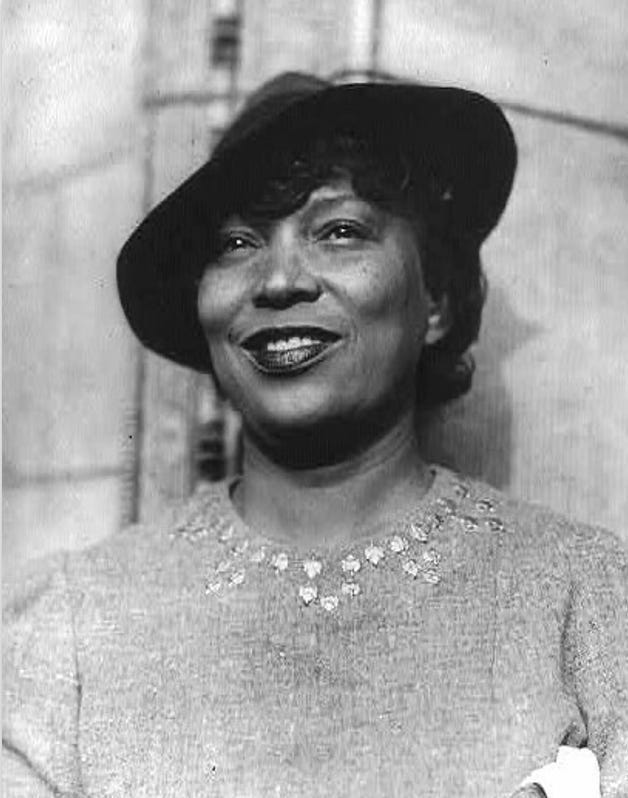
But some may not know that Hurston also suffered from depression, which intensified after she was falsely accused of a crime she did not commit. Her publishing career suffered, and her career as a novelist hit a plateau.
Alice Walker would become profoundly inspired by Hurston’s writings. Fifteen years after Hurston’s death, Walker published an essay, “In Search of Zora Neale Hurston,” in Ms. magazine in 1975, sparking renewed interest in her work.
Much of this history is documented in a book that both Minda and I recommend: “Wrapped in Rainbows: The Life of Zora Neale Hurston,” by Valerie Boyd, who researched and wrote the biography as a work of narrative nonfiction.

Boyd, who founded the MFA Narrative Nonfiction Program at the University of Georgia, died of cancer in 2022. Last year, I interviewed Moni Basu, who was close friends with Boyd, and now serves as the director of the low-residency program. It allows students to travel to Athens, Georgia for intensive stints to learn from expert nonfiction writers and teachers, and return home to work on reporting projects.
In “Wrapped in Rainbows,” Boyd detailed how, in response to one manuscript that Hurston submitted after already achieving literary success, an editor replied with a rejection:
“There are of course wonderful flashes of writing—as there always are in anything you do. But they are not enough to make this a good piece of your work. It is a hard thing to have to say, but I must tell you that we think the publication of this book would be a disservice to you. We would not do well with it, we are sure of that, and your reputation would suffer.”
Boyd noted how a Scribner editor wrote of Hurston’s novel, “The Golden Bench of God” (which was never published and is now lost), commenting on the story’s protagonist:
“A fine, warm, attractive character, but we can’t feel that this novel—the book as a whole—comes close to success. And the damn trouble is that we don’t know what to suggest in the way of revision.”
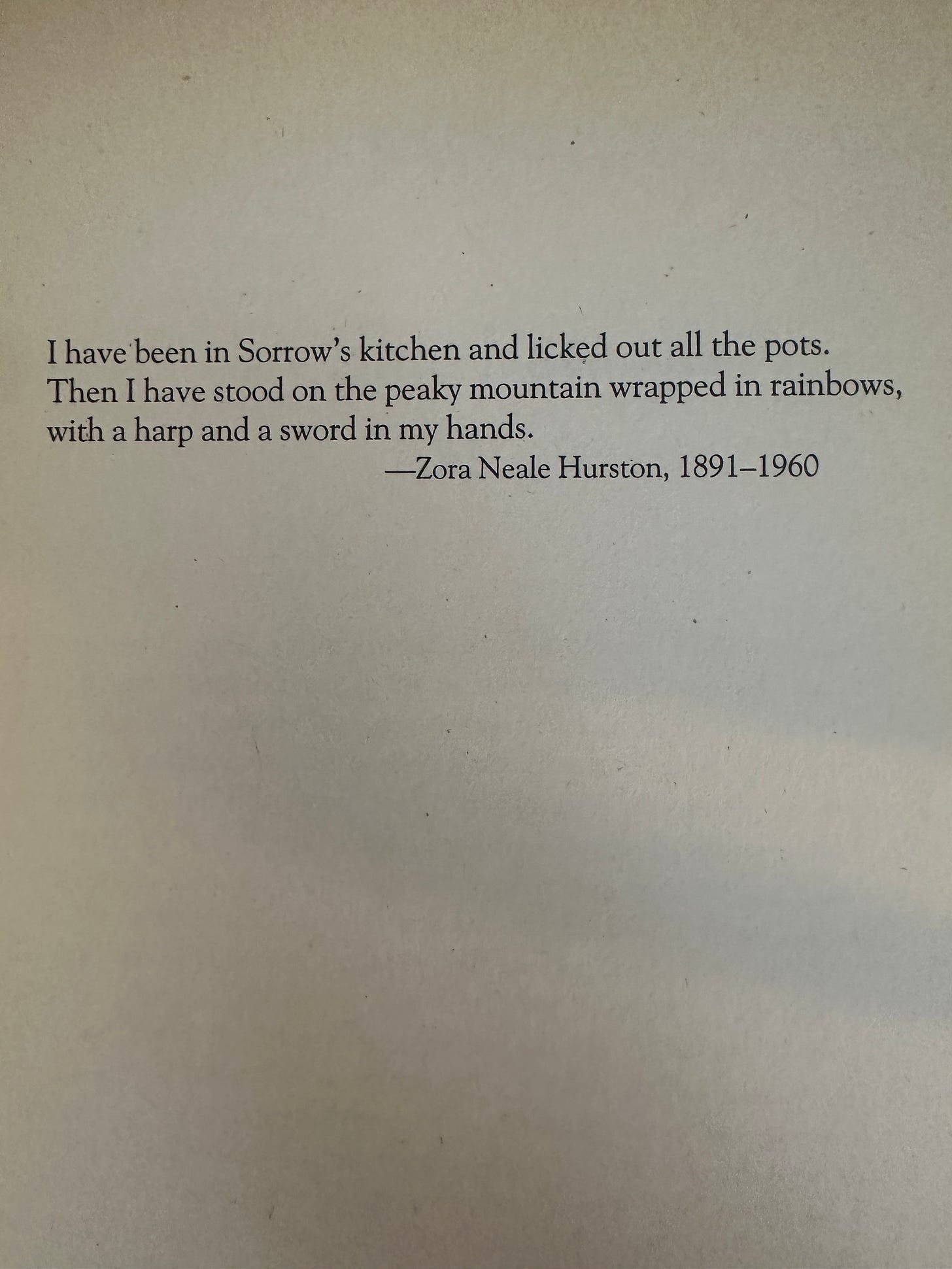
In the depths of her sadness and personal turmoil, Hurston once wrote:
“All that I have ever tried to do has proved useless. All that I have believed in has failed me…I have resolved to die. It will take a few days for me to set my affairs in order, and then I will go.”
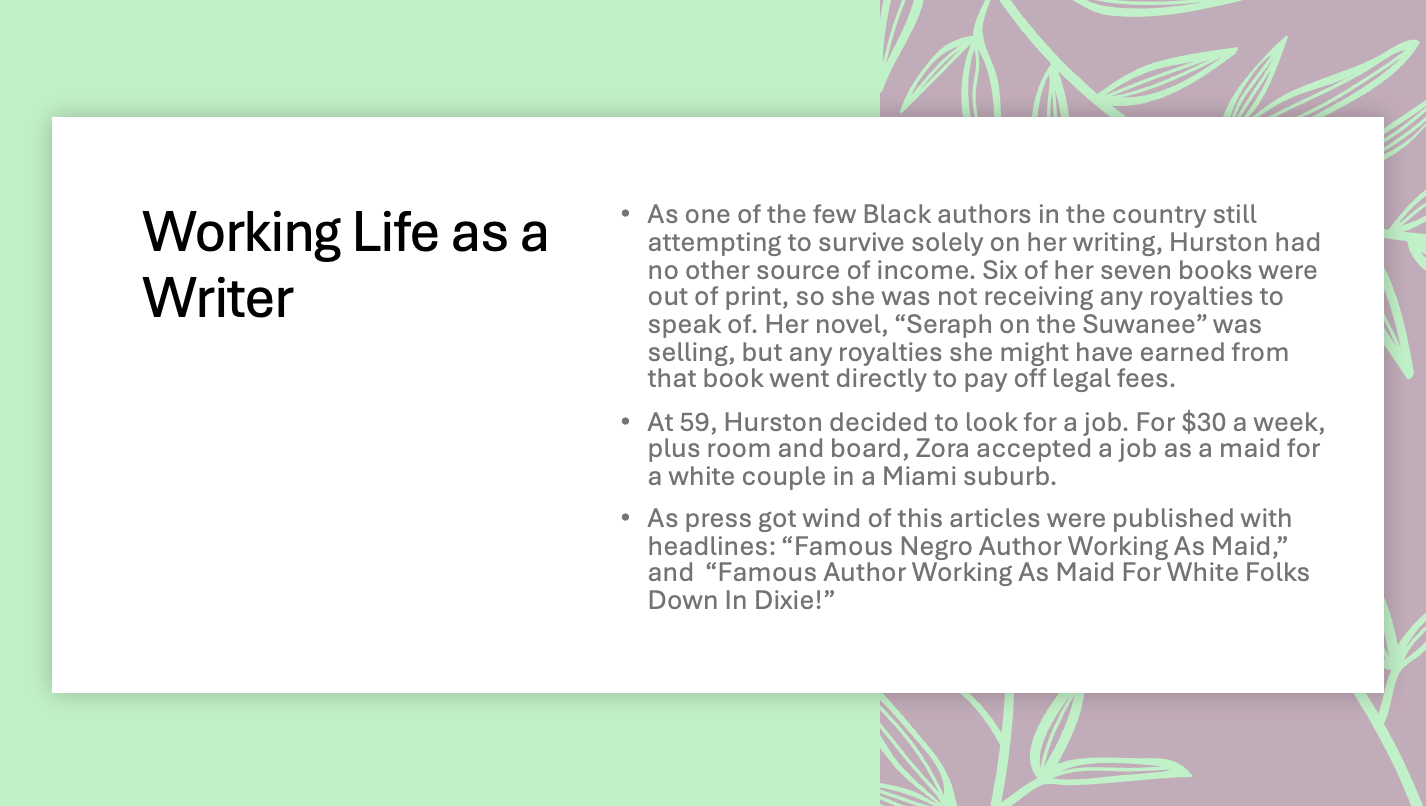
Dropping in a few of my class lecture slides below1
Hurston did not take her own life. She went on to live purposefully, publishing reported essays and narrative journalism on jazz, dance, folklore, and religion in Black culture.
She wrote a piece about her alma mater, Howard University. She profiled a Black cattle rancher. She published a portrait of Fannie Hurst, a prominent American novelist and screenwriter, based on the two weeks she spent traveling with her on the road. She also wrote a 1950 essay, “What White Publishers Won’t Print,” criticizing the publishing industry’s reliance on racial stereotypes.
Hurston also contemplated her own career choices, at one point writing:
“The inevitable question arises inside her. How much is a career worth to a woman anyway?”
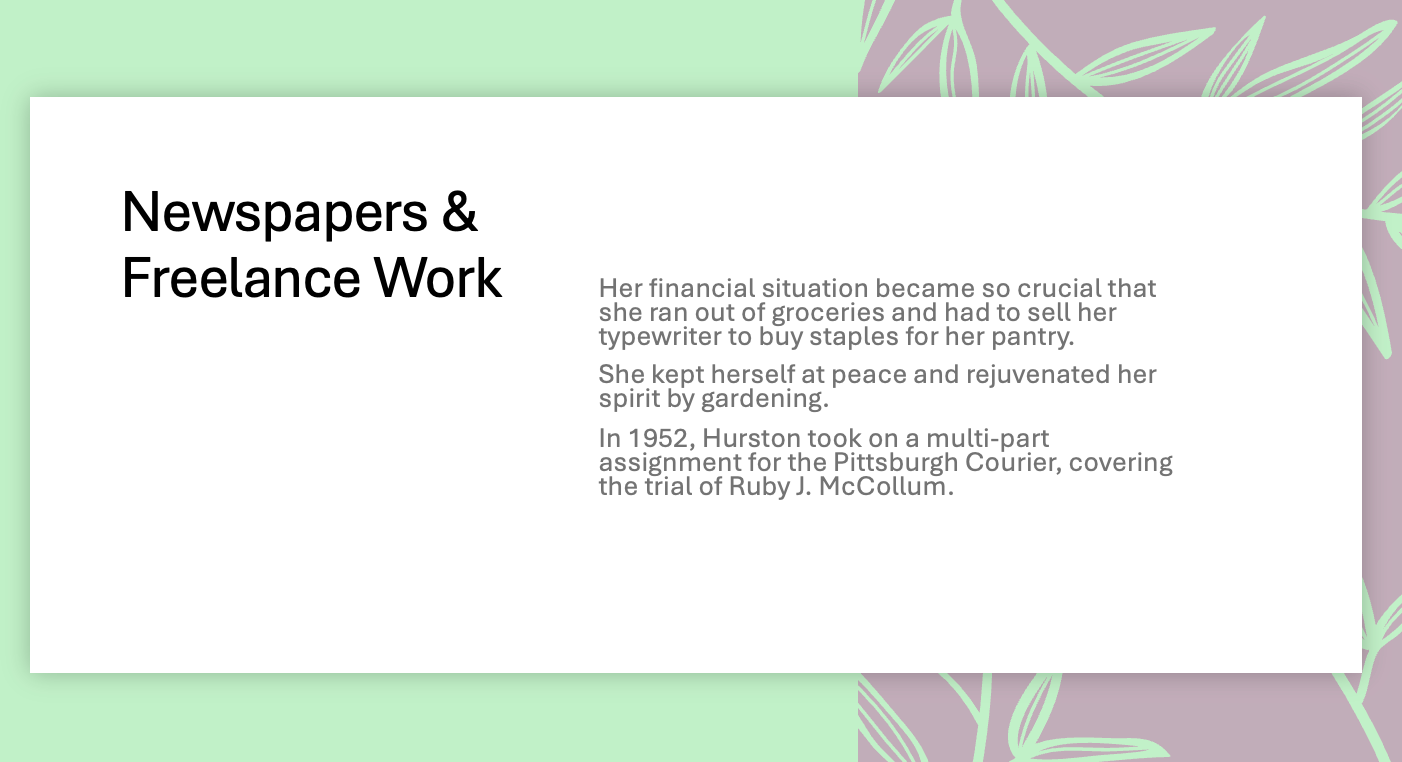
Hurston’s coverage of the trial of Ruby McCollum is a seminal work of literary journalism, but it is often left out of the canon of narrative nonfiction.
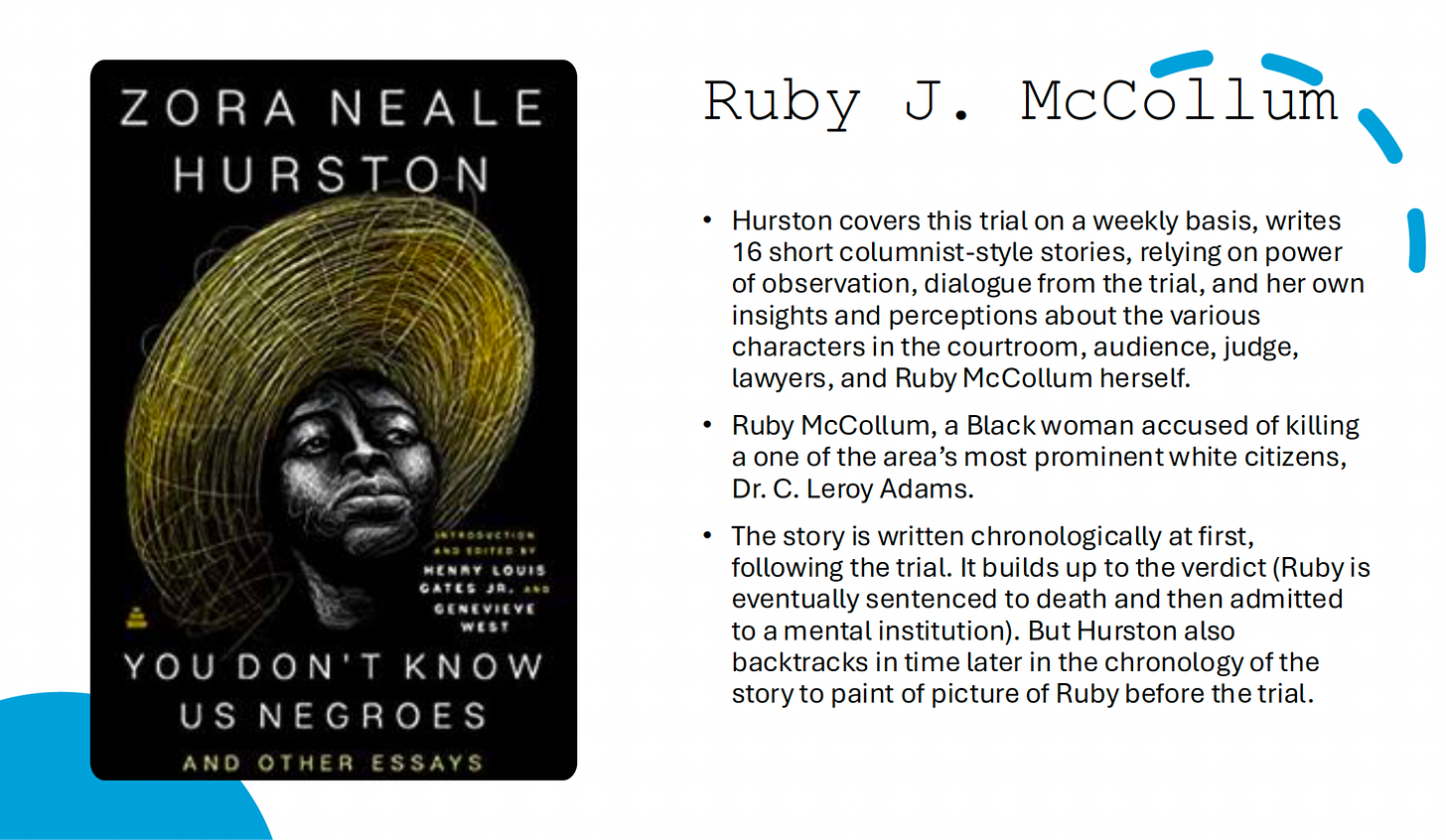
Hurston tried to piece together and make sense of McCollum’s story in an effort to dispel the dominant narrative—that she killed her doctor because she didn’t want to pay her bill—which denied the possibility of complicated sexual relationships that crossed racial lines, and flattened McCollum’s humanity.
I believe as nonfiction writers we are often searching for ourselves in the people and stories we write about. When my students read this series, some wondered if Hurston also saw a reflection of her own life in McCollum’s.
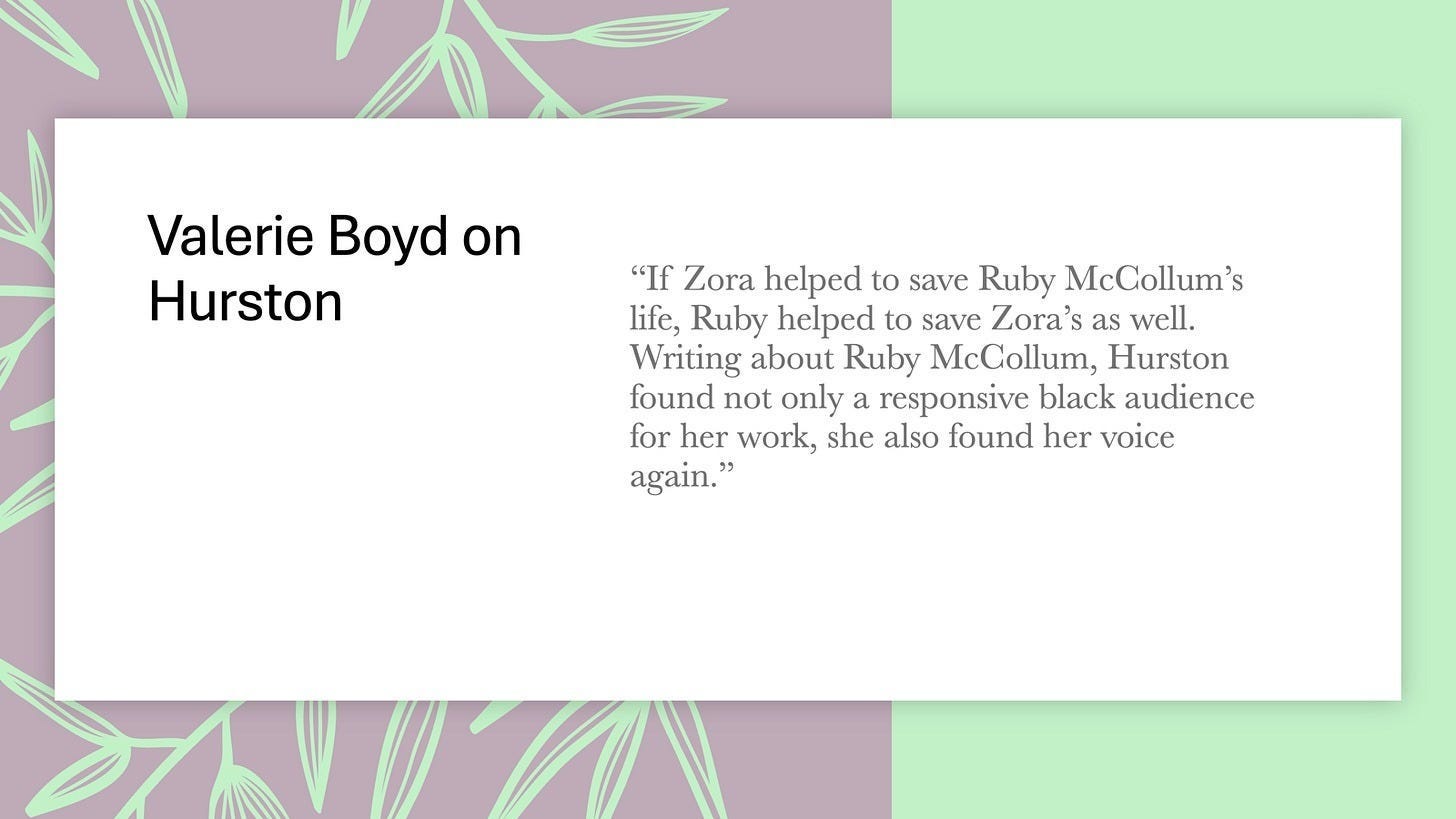
Eight years after publishing the series on McCollum, Hurston died of heart disease after suffering a stroke. In covering the trial and writing about McCollum’s life, she seemed to find her way back to these words, also documented in Boyd’s book, which Hurston wrote in 1926:
“To be brave costs something…It is so much easier to die out of one’s troubles than it is to live with them. It is much less painful to die for a principle than to live for it.”
*Sources for class slides include:
“Wrapped in Rainbows: The Life of Zora Neale Hurston,” by Valerie Boyd.
In my classes I also draw from the detailed literary journalism analysis, “From Fiction to Fact: Zora Neale Hurston and the Ruby McCollum Trial,” by Roberta S. Maguire in the journal Literary Journalism Studies.
“You Don’t Know Us Negroes,” forward by Henry Louis Gates Jr. and Genevieve West.
“Zora Neale Hurston: The Complete Stories,” introduction by Henry Louis Gates Jr., and Sieglinde Lemke.