
Speculation in Nonfiction
New video interview: Raksha Vasudevan on reported memoir, plus feature Pulitzer honorees

It’s Pulitzer Prize week, and you can find the list of winners and finalists here, including nominees in the features category, noted below:
Winner:
“The River House Broke. We Rushed the River,” by Aaron Parsley of Texas Monthly
Finalists:
“Can Anyone Rescue the Trafficked Girls of L.A.’s Figueroa Street?” by Emily Baumgaertner Nunn of The New York Times
“Mary Had Schizophrenia—Then Suddenly She Didn’t,” by Rachel Aviv of The New Yorker
I was honored (and intimidated) to serve as chair of this year’s Pulitzer Prize Nominating Jury in Feature Writing, and I talked to Mark Armstrong at Nieman Storyboard this week about what it was like to convene with a group of such sharp and thoughtful jurors.

Amid such celebrations, it is not lost on me that there has been a lot of lamenting lately that the nonfiction book industry in particular is in a crisis. Some are asking: “Are we falling out of love with nonfiction?” and “What happens when paperback nonfiction disappears?”
I’m hoping to do my small part in keeping conversations about nonfiction in the mix, showcasing people who write and read this particular form that many of us love and want to survive.
New ‘Writers Reading’ Video Series
Today, I’m launching a new video series, “Writers Reading: Conversations on the Craft of Nonfiction.”
Continuing The Reported Essay’s tradition of longform interviews, it will feature some of these Q&As as occasional recorded video chats, focusing on craft and discussing authors who inspire our work.
Today’s first recorded episode is with journalist Raksha Vasudevan, a 2025 Whiting Nonfiction Award Grantee for Works-in-Progress for her forthcoming book: “Empires Between Us: Estrangement and Kinship Across Three Continents.”
Raksha and I discussed her writing process, as well as the 2007 nonfiction book that has been a model for her: “Lose Your Mother,” by Saidiya Hartman, who traces the history of the Atlantic slave trade by recounting a journey she took across Ghana.
In “Lose Your Mother,” the author braids her own journey as narrator with deep historical and archival research, at times drawing from a narrative technique that she coined, “critical fabulation.” Saidiya’s method, which she also uses in “Wayward Lives, Beautiful Experiments,” draws from the language of speculation and imagination to reconstruct scenes in her storytelling.

In writing entire passages that are fictional accounts based on reality, she decides to “tell an impossible story and to amplify the impossibility of its telling.” This approach to nonfiction—while being transparent about moving into moments of fiction—seeks to redress history’s omissions, since the archives and records are filled with silences, especially around the lives of enslaved people.
Last week, my students read an excerpt from journalist Johanna Adorján’s “An Exclusive Love,” a reported memoir, which uses a similar technique. In Adorján’s book, she investigates the 1991 suicides of her grandparents, who survived the Holocaust and fled during the 1956 uprising in Budapest to Denmark. The spine of the narrative comes in Adorján’s speculative passages reconstructing the intimate moments and details she will never know about the day her grandparents killed themselves.

You can also consider the “language of perhapsing” in creative nonfiction in Maxine Hong Kingston’s “No Name Woman.”
Raksha Vasudevan
In 2018, Raksha left her job as an aid worker to build a freelance writing career. Eight years later, she has bylines in The New York Times, VICE, The Guardian, Outside, WIRED, and High Country News, where she was also a contributing editor. Her essays and commentary on colonial legacy and family estrangement have appeared in The New York Times Magazine, Harper’s Bazaar, Guernica, Hazlitt, The Washington Post, and LitHub.
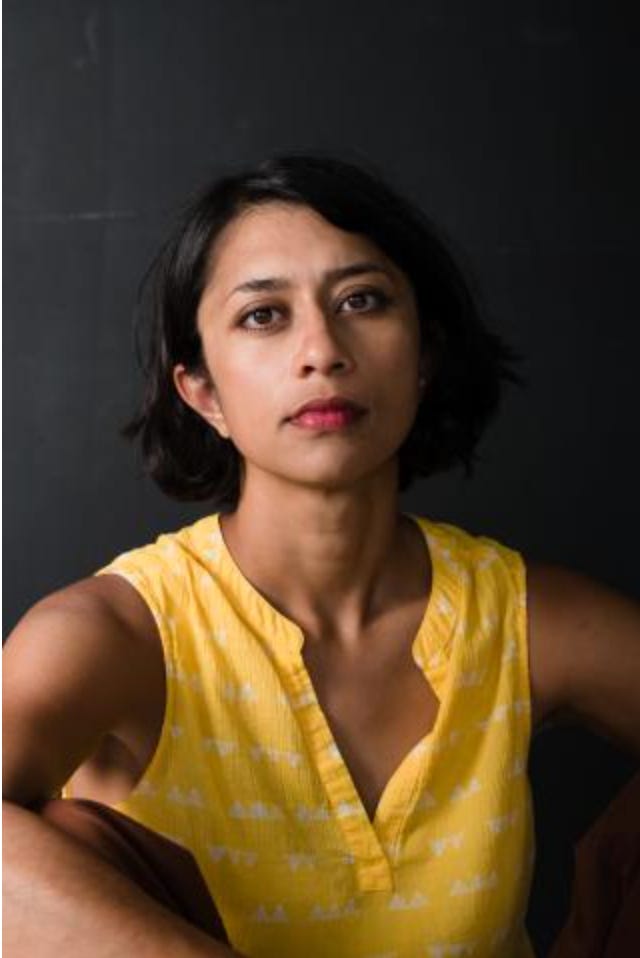
She publishes a newsletter, “Stranger Ties,” which is full of helpful reporting advice, including a post about what happens when a subject you write about gets mad at you after publication, or a field guide to writing residencies (Raksha has received fellowships and support from Ragdale, UCross, Storyknife, Mesa Refuge, the Canada Council for the Arts, and the Writers’ Trust of Canada). She also detailed her incredible saga of selling a nonfiction book.
She will be teaching a class on “Writing the Book Proposal,” for Off Assignment, with visits from Pilar Garcia-Brown, Senior Editor at Penguin Random House; Noelle Falcis Math, agent at Transatlantic Agency; Alex Marzano-Lesnevich, author of the “The Fact of a Body: A Murder & A Memoir,” and Irvin Weathersby, Jr., author of “In Open Contempt: Confronting White Supremacy in Art and Public Space.”
I hope you appreciate our video chat, and please forgive any rough spots as I am new to video editing. But thanks to multimedia journalist Natalie Tso, who recently gave a wonderful masterclass at the UCI Center for Storytelling, for giving me some guidance.
While my video chat with Raksha focuses mostly on book writing, she was also kind enough to visit my winter writing workshop at UC Irvine, “Narratives off the News,” over Zoom. For that discussion, she offered tips for pitching and writing magazine pieces, and I’ve included a few gems from that talk (which are not in our video discussion) here.
Raskha on Pitching & Building a Freelance Writing Career
Can you tell us how you learned to pitch magazine stories, and how you changed careers to become a freelance journalist?
I never went to journalism school. In my aid work in Africa, I did qualitative research, interviewing people, doing literature reviews, making recommendations. I loved the research and interviews, but I felt frustrated that my recommendations weren’t always used.
I also knew foreign correspondents and felt jealous. They got to tell stories without the pressure of “fixing” things. So I moved to the U.S., left my job in 2018, took writing classes, and started pitching. I made a lot of mistakes and got a lot of rejections, but I learned along the way.
There are sources, like the Open Notebook and the Nieman Storyboard, that I found super helpful for not just structuring a story, but also figuring out how to pitch.
My rejection rate, when I started off, was super high. The best advice that I have for pitching in general, especially when you’re starting out, is to try and get a story that is undeniable. It’s almost like, no matter how shaky your pitch is, it’s interesting enough that the editor is going to want to talk to you.
I knew a contributor to Wired, and she actually very kindly reviewed my pitch for me before I sent it. So that was super helpful. But I also think the story was so just in the magazine’s domain that I almost could have just totally botched the pitch, and they still might have wanted to talk to me, just because it was just in their specific area of focus.
The other advice that I have from my time as a contributing editor at High Country News, is really get to know the publication that you’re pitching for. Read their stories. Don’t be afraid to cold-email the editors, or someone who regularly contributes to the publication, and just say, “I really love your stories,” and mention you are working on a story idea. “Would you be open to having a conversation about it?” If they say no or don’t get back to you, no big deal.
Try to email a specific editor rather than general emails, because sometimes some publications check those emails and some don’t. Especially if you’re trying to do longform, the more pre-reporting you can do, the better. I know it’s not always possible, because obviously you’re not being paid to do the pre-reporting.
But especially if you’re starting out in your career, and you don’t have a lot of longform clips, I think the editor will want to know: Who are your characters, do you have access to them? What is the story arc? How are you going to reconstruct these particular scenes? Is it going to be through interviews? Is it going to be through public records requests? What other kinds of experts are you going to want to talk to?
You reported the longform piece for Wired: “3 Teens Almost Got Away With Murder. Then Police Found Their Google Searches.” Can you break down your reporting process?
This story was really heavily based on public records. So I got records from the fire department, which included photos, but also text about what the scene looked like when they got there. I got police body cam footage that showed the scene when the first police officers responded, so you could see the house on fire and everything else.
And then anytime there’s a police or government official who shows up on scene, they usually have to write a report about what they saw. And so all those details about the neighbor, and of course, I saw the footage of the house on fire from the neighbor’s camera. So a lot of it was based on going through paperwork and court records to reconstruct the scenes.
If you’re writing a longform story, the advantage is that you do have space to really get into detail, which makes the scene come alive for the reader. So in this case, both my editor and I wanted to make the scene as vivid as we could. I remember them specifically asking me, like, “Okay, these visual details are great, but what did it smell like? What did it sound like?”
And you had that in there, you had the smell of the air.
Yeah. That’s because my editor explicitly asked for that. For me, a lot of great longform pieces are defined by detail and how much specific detail the reporter is able to reconstruct, whether that’s through interviewing sources or through public records and other ways of gathering that material.
When you were parsing through the documents and all the public records, how did you decide what to include and what to use?
I think in terms of deciding what to include and what to lay out, the structure kind of changed as I was writing it. But we really tried to build a story around scenes and pivotal scenes.
At one point, someone suggested, “Why don’t you use AI to just go through the documents?” But aside from the ethical problem with that, you don’t know what details are going to be important until you come across them.
For example, the photos of these guys going on vacation after they committed the homicide, going to Mexico. AI is maybe not going to think that’s important, but that turned out to be a crucial detail. Because I wasn’t able to interview all the suspects, so all we had to go on was their actions. And so that photo became really important, but AI wouldn’t have picked up on that.
How did you figure out your structure?
I think with longform in particular, there’s this question I try to ask: What is this piece really about beyond the narrative? For the Wired piece, to me, it was about how dependent we are on technology and how it’s changing us in unexpected ways.
So I tried to plant those threads throughout, but the ending offered a chance to make it explicit. I wanted to leave readers with the same questions I had while writing. But writing just about the legal ruling would be boring. So the crime and investigation became the vehicle through which I told the story. The challenge was finding a structure that maintained suspense while also allowing us to explore the legal implications.
And I think once readers are hooked by the crime, they keep reading to find out what happened, which allows you to bring in those broader questions.
How does writing longform translate to the skills needed in writing a nonfiction book on a totally different topic?
The reporting and research skills that I’ve developed through journalism have been so key and so helpful to writing this book, especially in thinking through structure and how I’m going to weave in research and reporting in a way that doesn’t just feel like an information dump.
It’s something that I wouldn’t have been able to do if I hadn’t worked on these longform stories, and if I hadn’t had editors pushing me to build in more momentum and to think about restructuring.
If I had any advice to offer for book projects, it would be: If you are thinking about a book, try to pitch stories that will pay for your reporting. Try to pitch stories that will allow you to travel to places and interview people that might show up in your book. I mean, I know often it works the other way around, like journalists find stories through just like their regular beat reporting, but it can also work the other way as well.
I love what you did with the video cover and your voice sounds so great in the intro! You could definitely host a podcast with all the great interviews you do. Thanks for the mention!
Thanks for sharing this! And yes, I tried pitching my first nonfiction book to an agent recently, who kindly mentioned that the nonfiction market has been really slow. I wonder why that is, but it's encouraging to read interviews like this!